Posts

Showing posts with the label Moon

Roving for resources on an analog Moon

Image
Humans history is a story of exploration and expansion, whereby we have used our resourcefulness to settle nearly every environment on Earth. To accomplish these migrations, people have had to live off the land by hunting for food, gathering building materials, and mining resources needed for survival. It just wouldn't be practical or economical to bring everything you need with you. Space is the same way. Like on Earth, we will have to learn to use materials found in the space environment to become permanent residents of the extraterrestrial realm, rather than temporary campers . As I mentioned in the last post , I went to Hawai'i Island last week to take part in NASA's in situ resource utilization (ISRU) lunar rover field testing, facilitated by the Pacific International Space Center for Exploration Systems ( PISCES ) on the flank of Mauna Kea . The mission simulation successfully showed that a rover arriving on the surface of the Moon can find and verify the exi...

A RESOLVE to mine the Moon

Image
I will be on the beautiful Big Island of Hawaii next week working with the Pacific International Space Center for Exploration Systems (PISCES) . As I've described in previous posts , PISCES is an international research and education consortium headquartered at the University of Hawaii at Hilo that aims to develop, test, and validate technologies for use on the Moon, Mars and beyond. When humans return to the Moon and journey to Mars, they will have to live off the land. It's just too costly to bring everything we need with us. That includes rocket fuel for the return trip, water, oxygen, and other consumables. Thus, it is critical that we learn how to utilize in situ resources if we are to establish permanent presences on other worlds. As a geophysicist by profession, my interest lies with applying my terrestrial geophysical exploration knowledge to other planetary bodies. To this end, I carried out experiments at FMARS in 2009 and MDRS in 2010 to study the human f...

'Moon' is not a 4-letter word

Image
What is the most innovative and sustainable way to approach space research, education, and commerce beyond low Earth orbit? Those were the themes of the recent International Lunar Research Park (ILRP) Leader's Summit , which I had the privilege of attending thanks to generous support provided by the Silicon Valley Space Club and State of Hawaii . While last year's meeting dealt with identifying the "what", this year's meeting focused on the "how" aspects of those themes in the context of a research park. Developed first as a terrestrial prototype in Hawaii, this research park could later expand to the Moon. You can learn all about the concept on the ILRP website , the April 2011 ILRP Exploratory Workshop website , or Bruce Pittman 's Fall 2011 Ad Astra article titled "Been There...Never Done This!" . Ever since Obama quipped, "We've been there before" in reference to the Moon during his April 2010 speech cancel...

International Lunar Research Park Leaders Summit announced

Image
Hawaii is one of the most uniquely suited locations on Earth to practice and prepare for future lunar surface exploration.  I first blogged about the exciting  International Lunar Research Park (ILRP)  initiative last November.  I'm happy to report that the Hawaii-NASA partnership has built a great deal of momentum and is gearing up for its first targeted conference this November.   The following announcement of the ILRP Leaders Summit comes courtesy of the Hawaii Office of Aerospace Development . I hope to see you there! As the global economic recession poses increasingly significant challenges for nations worldwide, questions abound concerning the potential for humans to pioneer the frontiers of space. Yet many visionaries from around our planet, who recognize the substantial scientific, educational and commercial benefits of space exploration, are seeking to enhance the capacity for people to learn, work, and ultimately live beyond the Ear...

The Lunar Core

Image
As the self-professed " Astronaut Seismologist ," I am very excited by yesterday's NASA announcement confirming that the Moon does indeed have a core.  The news accompanies a report published in the journal Science by Weber et al.   Having just read the paper and its extensive supplemental material, I will devote this post to conveying my initial impressions of the research.  SPACE.com , Science Daily , Science , Discovery News , and Daily Mail had very public-friendly writeups on this story that are worth a look too.  If you prefer to listen, check out this NPR Science Friday interview with Renee Weber: Podcast Powered By Podbean The gist of the paper is that the moon has a solid inner core, a liquid outer core, and a mushy partially molten region above the outer core.  The Earth has all of these same features in its deep interior too.  Scientists have long suspected the Moon to have a core due to indirect evidence such as the co...

Towards establishing a Lunar Research Park

Image
Ask most people what they like about the Big Island of Hawaii, and you'll get responses ranging from enjoying its beaches to exploring its active volcanoes .  Astronomy buffs may highlight the world-class observatories on Mauna Kea or the 'Imiloa Astronomy Center in Hilo.  In fact, the elevation extremes of the island make it the most environmentally diverse place on earth, sporting all but one of the world's terrestrial climate zones , including desert, tropical, temperate, and even tundra. From an extraterrestrial perspective, this eco-range also means that Hawaii harbors very good planetary analog environments.  The high elevation, dry weather conditions, and lunar regolith-like volcanic deposits make Hawaii an ideal place to practice for missions beyond Earth.  That's why it served as a training ground for Apollo astronauts in the 1960s and why the PISCES (Pacific International Space Center for Exploration Systems) program has called Hawaii home since 20...

Lunar Science Forum

Image
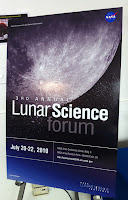
Last week I attended the 3rd annual Lunar Science Forum (LSF) held at the NASA Ames Conference Center .  The 3-day meeting sponsored by the NASA Lunar Science Institute (NLSI) dealt with topics "of the Moon, on the Moon, and from the Moon."  The LSF was one of several lunar- and space-focused meetings during the week that also included the LunarGradCon , Next Generation Lunar Scientists and Engineers Workshop (NGLSE), Lunar Exploration Analysis Group (LEAG), and NewSpace2010 .  I want to thank the NLSI for providing the travel grant that made it possible for me to attend the meeting. After introductory speeches from Ames Director Pete Worden (whom I know from ISU ), Jen Heldmann (whom I know from the PSSS ), and others, science journalist Andrew Chaikin delivered a very engaging an opening talk titled "Luna 2.0." One of his slides showed the LROC mission patch, which says in Latin "Science enables Exploration. Exploration enables Science." T...

Aquanaut Gravity Comparisons

Image
What is gravity like on the Mars compared to the Moon or an asteroid? See for yourself in this really cool video made by Astronaut Chris Hadfield and crewmates on the NEEMO-14 mission at the NOAA Aquarius Reef Base . If you're curious to learn more about the underwater habitat, check out the NEEMO-14 overview video and video tour of Aquarius too. For more great information on the NEEMO-14 mission, check out their Flickr photos , YouTube videos , Twitter profile , Facebook page , and mission support blog . Stay turned for a future post with more on aquanaut opportunities!

Seismology on the Moon

Image
When we go back to the Moon, we'll need to employ geophysics to study its interior and will glean important insights into understanding the origin of the Earth-Moon system. In the process, we'll also learn valuable information to help people live and work on the lunar surface. For example, we can characterize the seismic hazard and find resources of interest in the subsurface. Back in January 2010, I joined a small group of like-minded terrestrial and planetary geophysicists at the LunarGeo2010 meeting , which was held at Arizona State University. The LROC Outreach team was there interviewing some meeting participants on camera for their LRO Live! education and public outreach project. My interview video surfaced on the web yesterday: It was an honor to be included in the LROC Live! video project along with others such as Astronaut Harrison "Jack" Schmitt (a geologist who holds the record for EVA time on the Moon), Astronaut Drew Feustel (who fixed Hubb...

Earth and Space 2010

Image
Last week I attended the 12th annual Earth & Space 2010 conference .  The American Society of Civil Engineers ( ASCE ) sponsors the biennial meeting to bring together experts from a variety of disciplines to discuss exploration, engineering, construction, and operations in challenging environments both on Earth and throughout the solar system.  Civil engineering holds the key to solving many of the challenges needed to create sustainable outposts in hostile environments including providing power, mitigating low gravity and dust, protecting against radiation, using local resources, exploring the subsurface, and much more. The meeting was held at the Sheraton Waikiki hotel, which offered breathtaking views of the ocean, as shown from the window in the meeting facility here.  Tracks in the conference dealt with lunar and martian regolith materials, sustainable development, intelligent sensors, aerospace vehicle control, offshore wind turbines, fluid dynamics and he...

Meeting Astronauts Schmitt and Feustel at LunarGeo2010

Image
For the past two days, I have been at the Ground-Based Geophysics on the Moon workshop in Tempe, Arizona (aka: "LunarGeo2010"). This meeting is the first of its kind to bring together planetary and terrestrial geophysicists to review what we learned about the Moon from past geophysical studies and to plan future studies - robotic and human. Astronaut Jack Schmitt gave the first keynote address. He related his experiences doing active seismic experiments during the Apollo 17 mission.  He was the only professional scientist to ever visit the Moon and holds the record for the most EVA time spent working outside on another planetary body (22 hours).  The Moon is the only place in the solar system where humans have carried out ground-based geophysical studies such as seismology, heat flow, electromagnetic soundings, and gravity.  Without the data Schmitt and his Apollo colleagues collected, we would know significantly less about lunar interior and history, and by extens...

Space Simulators

Image
Let's face it. Until the cost of spaceflight significantly decreases, only a few highly qualified and lucky people will be selected as astronauts to fly in space. But that doesn't mean they have to have all of the fun. Here are some free space simulators you can download to hone your skills. Some are targeted at students for educational purposes, some are just for fun, and others are real research tools used by NASA. ORBITER ORBITER is a free flight simulator that goes beyond the confines of Earth's atmosphere. Launch the Space Shuttle from Kennedy Space Center to deploy a satellite, rendezvous with the International Space Station or take the futuristic Delta-glider for a tour through the solar system. Many addons that expand the simulator's capabilities are available. ( Windows only)   

Terraforming Mars

Image
The big news yesterday was NASA's annoucement that LCROSS definitely exhumed water in its October 9 impact into the Moon. That's good news because it confirms the presence of water on our closest neighbor. This means we have a ready source of hydrogen, oxygen, and water for rocket fuel and life support. It makes the prospect of establishing a permanent human base on the Moon much more feasible. Almost every space blog seems to have written something about this landmark discovery, so I won't repeat it here (The New York Times had a nice article.) Congratulations to the LCROSS team! One day in the hopefully not-too-distant future we'll have a permanent research base on the Moon, but it'll likely be operated much like McMurdo Station, Antarctica is here on Earth. It'll require frequent resupply of life's necessities, and in the event of emergencies, people can leave. The Moon will probably never support a large human civilization, but Mars could be...

Lunar exploration, orbital flight, and more

Image
The past few days were busy for space news. Here are some of the interesting stories I've been following: 14-day Simulated Lunar EVA Ends (Sept. 14) NASA's Desert RATS (Desert Research and Technology Studies) is a working group of researchers who conduct field tests of operations and technologies under planetary analog EVA conditions. This summer, they've been in the desert near Flagstaff AZ testing, among other things, the Lunar Electric Rover (LER) (the same one I blogged about previously ). Astronaut Mike Gernhardt and geologist Brent Garry spent 14-days living in the LER conducting a simulated lunar mission. They drove the rover around, tested its new spacesuit docking ports, conducted geological EVAs, and even docked the rover to a simulated lunar habitat module . The 14-day simulated lunar mission drew to a close yesterday on September 14. OnOrbit broadcasted the crew emerging from the LER live on ustream, which is archived here .

AsHos Must Keep Hoping

Image
A few days ago, the Augustine Commission released its Summary Report ( pdf , html ) reviewing the U.S. human spaceflight program. In a nutshell, they recommend that NASA needs $3 billion more annually to maintain its planned human space exploration program and that the gap in U.S. human launch capability will be at least seven years. The first two sentences of the 12-page document set the ominous mood: The U.S. human spaceflight program appears to be on an unsustainable trajectory. It is perpetuating the perilous practice of pursuing goals that do not match allocated resources. With this bleak budget outlook and the reality that 19 new AsCans are now in training at NASA , CSA , ESA , and JAXA , the space agencies are not likely to be taking any additional recruits in the foreseeable future. What does this mean for Astronaut Hopefuls (AsHos) like you and me? First, let's review the report.

Moon 101

Image
I stumbled upon an excellent lecture series called "Moon 101 - A Course in Lunar Science for non-specialists" , which was presented by Dr. Paul Spudis and other lunar experts to NASA Johnson Space Center employees from June-October 2008. The lectures cover a range of topics related to lunar geology and exploration in a form that's easy to understand. They are available both in video and PDF slide forms. Although the website says the videos only work with Internet Explorer or Netscape, I found that they worked just fine in Firefox on a Mac (not Safari though).

To the Moon or Mars?

Image
40 years ago yesterday Apollo 11 blasted off from Earth on its way to its historic July 20 landing on the Moon. NASA has a big celebration campaign underway in honor of the anniversary. They recently released very nice partially restored Apollo 11 video footage in HD. One of the interesting things NASA is doing to commemorate the anniversary is replaying the mission audio in real time just as it was recorded from July 16-24, 1969. The NASA Apollo 40th website has all kinds of other goodies like lost audio and transcripts that are worth checking out too. For more blast from the past nostalgia with a modern twist, the website "We Choose the Moon" is also broadcasting the mission audio with other rich multimedia treats, including "live" twitter transmissions from the Apollo CapCom , spacecraft , and lander . I have ambivalent feelings about the Apollo 40th anniversary. One one hand, I think this celebration to commemorate one of humanity's most signif...

Buzz Aldrin's Rocket Experience

To commemorate the 40th anniversary of the first Apollo Moon landing, Buzz Aldrin teamed up with Snoop Dogg and Talib Kweli to make a rap video called "Rocket Experience", which you can watch below. There's also a really funny video on the Making of the Rocket Experience . These videos are on YouTube too in case you want to watch them there. According to Funny or Die , who produced the video, a portion of the proceeds from the song sales will go to ShareSpace Foundation , to further benefit and support the work of the National Space Society , The Planetary Society and the Astronaut Scholarship Foundation . Buzz Aldrin's Rocket Experience from Buzz Aldrin

The End of Kaguya and Beginning of LRO

Image
The Japanese lunar orbiter with the impressive HDTV camera has met its end as mission controllers guided it to the surface for a planned impact in a shaded region near Gill Crater at approximately 89°S, 266°E (In a June 11 press release , JAXA showed the impact site location.). As it approached the moon, Kaguya took a series of still images, which are available in the June 19 JAXA press release or in the animated sequence I created from them below: The LTVT wiki has collected a lot of information on the impact itself. Jeremy Baily and Steve Lee observed the impact from the Anglo-Australian 3.9m Telescope at Siding Spring, New South Wales, Australia. You can learn more on their webpage , or take a look at their image showing the impact in a sequence of four frames: More stunning lunar images from Kaguya are available in the mission's image archive . In other lunar news, the Lunar Reconnassiance Orbitor (LRO) had a successful launch yesterday from Cape Canaveral aboa...

Moon: the movie

Image
Blog reader Ben tipped me off to a really interesting movie called Moon . It stars Sam Rockwell as an astronaut spending a three year solo mission on the Moon mining Helium-3, which could be an important source of fuel for clean nuclear fusion . His only companion at the lonely outpost is his robot, voiced by Kevin Spacey . The suspense heats up in this scifi thriller as, just before he's set to go home, Rockwell realizes he's not alone. You can watch a clip below. There are more clips and images here and here . If Rockwell's performance in Confessions of a Dangerous Mind is any indication, this should be a real treat.