Posts

Showing posts with the label FMARS

AGU Younger Scientist Video Profile

Image
Last year the American Geophysical Union ( AGU ) put out an open call for entries to its "Younger Scientists Video Profiles" project, so I applied. The main purpose of the project was to attract kids to geoscience careers and to give the public a better understanding of what AGU member scientists do.  My tsunami work and astronaut ambitions gained their attention, so AGU representatives interviewed me on camera at the Exploratorium in San Francisco during last December's AGU Fall Meeting . Later, they featured me in a blog post about the Chile tsunami too.  At long last, now my video profile has been posted on the AGUvideos YouTube channel . It features footage taken both in San Francisco and on my FMARS mission . Check it out: You can see still photos from all of the Younger Scientists who participated in this project on the AGU Facebook page and Flickr Photostream . Special thanks to MJ for making this happen.

Comparing FMARS and MDRS

Image
Now that I've been home from MDRS for a month, I want to pause and reflect upon the experience. In particular, I want to compare MDRS to its sister Mars base FMARS , where I spent July of last year.  I am now a member of a small club who can proudly say we have done a tour at each station, which are the only two mock Mars habitats in existence (for now).  

LPSC Poster on Mars Analog Geophysics

In addition to the excitement from the Chile tsunami , this week is also host to the 41st Lunar and Planetary Science Conference (LPSC) in The Woodlands, Texas.  Back in 2004, I attended the LPSC meeting, which is the world's premier gathering of planetary scientists, and I am happy to have a contribution to this year's LPSC.  On Thursday, I will be virtually presenting research findings from the geophysics projects I did at FMARS and MDRS , including the seismic station installation , electromagnetic survey , and seismic refraction survey .  I say virtually because I unfortunately won't be there in person; instead a colleague will present the poster for me.  You can read my 2-page abstract online or see the full poster below: LPSC 2010 Poster

AGU Recap

Image
I've had a busy AGU Meeting . The week has passed as a blur of meandering through the maze of posters, dropping into and out of oral presentation sessions, and plenty of bumping into people whom I've known over the years. In this post I'll highlight some of the things I found interesting. Day 1    |  Day 2    |  Day 3    |  Day 4  |  Day 5 Day 1: Monday, December 14 As I reported last time , I presented a poster about FMARS on Monday. I'm happy to report that it went very well, and I struck up some good conversations with people about the analog Mars research project.  The question I got asked the most was how we tracked traffic on our website or followers in social media.  My answer was that we didn't but will next time.  My poster was next to one from the Exploratorium on their Ice Stories project, which I have been following with great interest for the past year. I spent the afternoon cruising poster...

AGU Overview

Image
I am privileged to be spending the week in one of my favorite places: San Francisco. The city is famous among geeks for being more than the future home of Starfleet Academy ; it also hosts the annual American Geophysical Union Fall Meeting (AGU). This is my fifth time attending the meeting in the past nine years, and each time I come back it feels like returning to a familiar home. The conference is the world's largest gathering of earth and space scientists. According to the AGU Fall Meeting Blog , more than 16,000 attendees will descend upon the Moscone Center to give 15,516 presentations in 1,293 sessions this year. Topics range widely from aeronomy, atmospheric sciences, biosciences, climate science, cryosphere science, education, environmental change, geochemistry, geodesy, geology, geomagnetism, geophysics, heliophysics, hydrology, informatics, minerology, natural hazards, ocean sciences, planetary sciences, public affairs, rock physics, seismology, tectonophysics, ...

FMARS Retrospective

Image
A month has passed since I returned to "Earth" from my FMARS adventure on Devon Island. I feel I now have sufficient perspective to reflect upon the experience. This post will summarize my impressions, lessons learned, and recommendations for the future. I am very grateful to The Mars Society for choosing me as a crewmember on this expedition. Taking part in the mission was an honor and privilege, and I hope this experience can lead to other opportunities in the future.

Listen for Me on The Space Show

Image
I will be Dr. David Livingston's guest on this Sunday's episode of The Space Show from 9:00am-10:30am Hawaii time (12:00pm Pacific, 1:00pm Mountain, 2:00pm Central, 3:00pm Eastern, ...). Our main topic of discussion will be the FMARS 2009 expedition . Listeners can talk to me or the host during the program by calling toll free 1-866-687-7223, sending email to drspace@thespaceshow.com (or dmlivings@yahoo.com, thespaceshow@gmail.com), or chatting on AIM/ICQ/CompuServe Chat using the screen name "spaceshowchat". You can listen to the show live via its website or RSS feed/podcast , which is also available in iTunes. If you can't catch the show live, you can always listen to the archived mp3 version later or click below to listen to it from the convenience of this blog (after September 6). More information on my appearance is available on The Space Show website . Podcast Powered By Podbean

FMARS Video #9: From Gypsum to Water

Recall last month's post on our FMARS EVA to Gemini Hills to collect gypsum. I just finished editing some video of Vernon's water extraction demonstration and uploaded it to YouTube . This is my ninth FMARS video episode , and it may be my last unless I can eek out some time to make another one (maybe of our UAV flights ).

Mapping FMARS EVAs

Image
In addition to my seismic and electromagnetic projects, I made other significant contributions to the FMARS 2009 mission , including creating our mission patch and all of our EVA maps . In this post, I'll describe the maps. These are more more than mere geographic illustrations since they include georeferenced photos, heart rate and other information. My main goal was to integrate geotagged photos and GPS tracks within the geographic context of Google Earth to help the interested public share in our experiences. To accomplish this, one first needs geotagged photos. Last year, Wired Magazine had a good article introducing the concept, and an Outdoor Photography article summarized the concept nicely: Geotagging is a way to add location or GPS data to your photos to help you organize, search, find and share your images. In the past, it was difficult for even the most advanced photographers to geotag images. There was a patchwork of technology that could do it, but it w...

Beard Blog

Image
There's hair on my face. Maybe you're wondering why. One of my least favorite things about "normal" life is shaving. It's time-consuming and painful. Plus, a few hours after going through all of the trouble to shave, the hair comes back. When I started doing scientific field work about 11 years ago I made myself a promise: Field work time is a holiday from shaving.

FMARS Summary

The FMARS-XII 2009 expedition reached its formal conclusion at the 12th Annual International Mars Society Convention . Four of the six crewmembers were able to attend the meeting and address the Convention last night. I unfortunately could not be there, so I recorded a video to show in my absence. You can watch my video blog #7 here: The Mars Society press release summarizing our accomplishments is reproduced below:

Last days on Mars

Image
The FMARS crew is back in the relative metropolis of Resolute Bay now after having spent nearly a month in near-isolation in the Mars analog environment of Devon Island. We spent our final two days at FMARS going through the Hab shutdown procedures, mainly inventory and winterizing. That includes cleaning, organizing, flushing the water lines, wrapping the generators, burning the trash, taking exit photos, and a million other tasks. The majority of my time those days was consumed burning trash in our incinerator and ferrying loads of stuff to the air strip. We ended our formal simulation period after EVA 16 on the evening of July 26 just in time to have dinner with our neighbors at the HMP camp. It rained on us as we drove over, and two of our ATVs died due to the water. We arrived at HMP soaked and hungry. I was amused by how we all put on our best clothes and combed our hair to "go out" on our first meeting with outsiders in a month. The food and company couldn...

EVA Epilogue

Image
For my last EVA, Christy joined me in retrieving the seismic station we had installed earlier at Marine Rock. We left the Hab on an overcast day between rain showers and managed to stay dry for the duration of the EVA ( #15 ). A quick 15-minute drive later, we were at Marine Rock.   

Water and Electricity DO Mix on Mars

Image
I'm very tired from just having completed five EVAs over five consecutive days (July 19-23). One of these EVAs was to Gemini Hills to find gypsum , and the other four were all related to to my second geophysical research project. Recall from a previous post that I successfully installed a seismic station for my first geophysical project. This new experiment is even more ambitious. I'm trying to find groundwater using the time domain electromagnetic ( TDEM ) method. Before diving into this experiment, I'll share my next video blog entry #6 with you. It's all about water usage at FMARS:

Of Gemini and Gypsum

Image
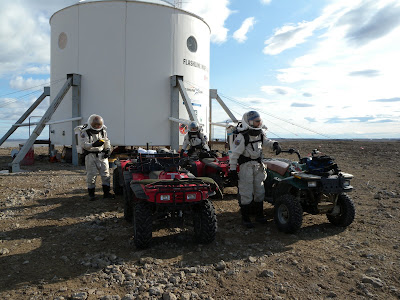
July 20 was going to be a day off for the crew, both because we needed it and in honor of the 40th Apollo 11 and 33rd Viking 1 landing anniversaries. However, we awoke to beautiful weather conditions, and Vernon presented a compelling argument that motivated the crew to embark on a long-distance EVA to Gemini Hills in order to collect gypsum samples. Our 22.6-mile traverse was full of adventure, a wild hare encounter, and healthy dose of getting lost. Before I describe the trip to Gemini Hills, I'd like to share my latest FMARS video blog entry #5 . This one is all about our space suits and how we prepare for EVAs.

Postcard from Mars

Image
Hello from FMARS ! Would any of you like to receive a postcard from "Mars?" Donate to my chipin fund , and I'll send you a postcard all the way from Mars (well, Canada - close enough). If you give at least $60, I'll send you a patch too. Many thanks to everyone who has contributed so far. You can preview the card, courtesy of Keplinger Designs below:

FMARS Video #4: Exercise

Recall my post last week on the Haughton Crater Run . Now that the FMARS mission is fully underway, I can no longer go outside to exercise. Instead, I must work out inside the FMARS Hab. My latest FMARS crew video blog episode highlights the exercise facilities here:

The Astronaut Seismologist

Image
Last night as the FMARS crew was sitting down for dinner after a long day of work, we checked the weather forecast and noticed that high winds and colder weather were expected starting the next day. Although I was already pretty tired after my first real EVA the day before and being the out-of-sim person on EVA #4 that day, I decided that getting the seismic station installed then was important given the potentially worsening weather situation. I asked for volunteers to go help me; Vernon and Christy stepped forward. We started suiting up after dinner and were out the door by about 8:30pm. Christy and I were in sim (wearing mock space suits), and Vernon served as our polar bear watch and photographer. After the usual trouble getting our ATVs to run, we managed the 3 km traverse to Marine Rock without any difficulty. The pictures below show Christy and I carrying all of the equipment we needed to install the seismic station. This particular setup is very compact and lightweig...

My Martian Birthday

Image
Today is my birthday. I've actually spent my 20, 21, 30, and 31st birthdays all in the arctic. The pictures below compare me when I turned 21 on the Juneau Icefield Research Program expedition with me at FMARS earlier today. I'm actually wearing the same pants and shirt in both pictures! In the photo on the right, I'm showing off the pancakes Kristine made for me in honor of my birthday this morning. This decade has flown by, and it's certainly had it's fair share of twists and turns that I could never have anticipated.    Today is also the first official day of our full Mars mission simulation. That means we can no longer go outside without space suits, we have to observe a 20-minute communication delay protocol with "Earth," and we're finally starting the research phase of our mission. This is why we're here. I wish it hadn't taken us until the midpoint of our expedition to reach this point, but we'll just have to adjust ...

FMARS Hab Tour and Last Non-Sim Day

Image
While most of the crew spent the morning hauling trash to the airport to be taken out on a flight scheduled for later in the day, I took the opportunity to capture some video inside the Hab, which I assembled into Episode 3 of my FMARS video blog (Sorry some of it is out of focus.). After lunch, we completed most lingering items on our pre-sim to-do list, including a surprise fire drill, testing bear bangers, firing the shotguns, flying the UAV, and receiving our last scheduled twin otter flight of the put-in phase of the expedition. Today was a beautiful day on Devon Island with temperatures in the 50s °F (10-15 °C) and mostly clear skies. It was warm enough not to need a coat.