Posts

Showing posts with the label conference

My ICES 2013 Experience

Image
Last week I had the honor of representing HI-SEAS at the 43rd International Conference on Environmental Systems (ICES) in Vail, Colorado. With over 260 attendees, the meeting featured more than 200 technical presentations on topics related to human spaceflight, including environmental control and life support systems, thermal control systems, EVA systems, habitats, terrestrial analogs, and aerospace human factors. As a non-engineer, I found myself a bit out of my element, which made everything I learned all that more exciting. This post provides short summaries of the talks I found most interesting at the conference, as well as the poster I presented there. ICES began with a keynote address by John Curry of Sierra Nevada Corporation (SNC) on "Dream Chaser: The Future of Human Spaceflight." The Dream Chaser traces its heritage back to several lifting body craft such as the X-24A, M2-F3, and HL-10 vehicles which were developed in the 1960s. After Russia successfully...

Launching Research at NSRC 2013

Image
The 2013 Next-Generation Suborbital Researchers Conference (NSRC) took place earlier this week in Broomfield, Colorado. This year's suborbital science meeting had some big shoes to fill after featuring a keynote by Neil Armstrong last year , but it did not disappoint. NASA's Deputy Administrator Lori Garver surprised everyone by stating the space agency may start funding researchers to fly with their spaceflight experiments, as this Space News article by Jeff Foust so eloquently summarized: "NASA officials said this week that, for the first time, they are open to funding flights of people, and not just experiments, on commercial human suborbital launch vehicles expected to enter service as early as next year." For over a year, my colleague in Astronauts4Hire has been navigating the tricky policy ground between NASA's desire to accelerate the commercial human spaceflight industry with its conservative need to minimize liability to achieve research resul...

Enabling Sustainable Planetary Surface Exploration

Image
I had the distinct privilege of participating in the 2012 PISCES Forum  last week on the Island of Hawaii.  Like the  2011 and 2010 meetings that I attended, this year's gathering focused on developing a research park in Hawaii devoted to planetary analog research in the context of sustainable space exploration . Dr. Buzz Aldrin was among the delegates participating in this year's PISCES conference, where he gave a keynote presentation on colonizing Mars through a sustainable strategy based upon Aldrin cyclers . With only about 50 people at the conference, there were many opportunities to interact with him closely. We spoke about how his father contributed to the early days of rocketry, what architecture is best suited for establishing a permanent Mars settlement, and what it takes to be an astronaut. He encouraged me to keep pursuing my goal of being an astronaut. Having met Neil Armstrong earlier this year, I am profoundly humbled to have met both Ap...

One small step for Suborbital

Image
We are moving from an era of limited government-controlled space access using very expensive vehicles to more affordable systems developed by the private sector that can provide frequent trips to space for a variety of purposes.  Multiple companies are rushing to be the first to market, including Virgin Galactic , XCOR Aerospace , Armadillo Aerospace , Blue Origin , and Masten Space Systems . Their varied technological approaches and flight plans offer researchers a great deal of options for studying the suborbital realm.  The sky is not the limit! Last month I attended the 2012 Next Generation Suborbital Researchers Conference (NSRC) in Palo Alto, California.  The purpose of the conference was to kickstart the imaginations of scientists who may utilize suborbital platforms for research.  Whereas tourism has driven much of the initial investment in the burgeoning new paradigm for space access, it is the research market that stands poised to provide the long-standi...

'Moon' is not a 4-letter word

Image
What is the most innovative and sustainable way to approach space research, education, and commerce beyond low Earth orbit? Those were the themes of the recent International Lunar Research Park (ILRP) Leader's Summit , which I had the privilege of attending thanks to generous support provided by the Silicon Valley Space Club and State of Hawaii . While last year's meeting dealt with identifying the "what", this year's meeting focused on the "how" aspects of those themes in the context of a research park. Developed first as a terrestrial prototype in Hawaii, this research park could later expand to the Moon. You can learn all about the concept on the ILRP website , the April 2011 ILRP Exploratory Workshop website , or Bruce Pittman 's Fall 2011 Ad Astra article titled "Been There...Never Done This!" . Ever since Obama quipped, "We've been there before" in reference to the Moon during his April 2010 speech cancel...

International Lunar Research Park Leaders Summit announced

Image
Hawaii is one of the most uniquely suited locations on Earth to practice and prepare for future lunar surface exploration.  I first blogged about the exciting  International Lunar Research Park (ILRP)  initiative last November.  I'm happy to report that the Hawaii-NASA partnership has built a great deal of momentum and is gearing up for its first targeted conference this November.   The following announcement of the ILRP Leaders Summit comes courtesy of the Hawaii Office of Aerospace Development . I hope to see you there! As the global economic recession poses increasingly significant challenges for nations worldwide, questions abound concerning the potential for humans to pioneer the frontiers of space. Yet many visionaries from around our planet, who recognize the substantial scientific, educational and commercial benefits of space exploration, are seeking to enhance the capacity for people to learn, work, and ultimately live beyond the Ear...

Towards establishing a Lunar Research Park

Image
Ask most people what they like about the Big Island of Hawaii, and you'll get responses ranging from enjoying its beaches to exploring its active volcanoes .  Astronomy buffs may highlight the world-class observatories on Mauna Kea or the 'Imiloa Astronomy Center in Hilo.  In fact, the elevation extremes of the island make it the most environmentally diverse place on earth, sporting all but one of the world's terrestrial climate zones , including desert, tropical, temperate, and even tundra. From an extraterrestrial perspective, this eco-range also means that Hawaii harbors very good planetary analog environments.  The high elevation, dry weather conditions, and lunar regolith-like volcanic deposits make Hawaii an ideal place to practice for missions beyond Earth.  That's why it served as a training ground for Apollo astronauts in the 1960s and why the PISCES (Pacific International Space Center for Exploration Systems) program has called Hawaii home since 20...

Lunar Science Forum

Image
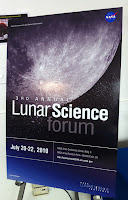
Last week I attended the 3rd annual Lunar Science Forum (LSF) held at the NASA Ames Conference Center .  The 3-day meeting sponsored by the NASA Lunar Science Institute (NLSI) dealt with topics "of the Moon, on the Moon, and from the Moon."  The LSF was one of several lunar- and space-focused meetings during the week that also included the LunarGradCon , Next Generation Lunar Scientists and Engineers Workshop (NGLSE), Lunar Exploration Analysis Group (LEAG), and NewSpace2010 .  I want to thank the NLSI for providing the travel grant that made it possible for me to attend the meeting. After introductory speeches from Ames Director Pete Worden (whom I know from ISU ), Jen Heldmann (whom I know from the PSSS ), and others, science journalist Andrew Chaikin delivered a very engaging an opening talk titled "Luna 2.0." One of his slides showed the LROC mission patch, which says in Latin "Science enables Exploration. Exploration enables Science." T...

Earth and Space 2010

Image
Last week I attended the 12th annual Earth & Space 2010 conference .  The American Society of Civil Engineers ( ASCE ) sponsors the biennial meeting to bring together experts from a variety of disciplines to discuss exploration, engineering, construction, and operations in challenging environments both on Earth and throughout the solar system.  Civil engineering holds the key to solving many of the challenges needed to create sustainable outposts in hostile environments including providing power, mitigating low gravity and dust, protecting against radiation, using local resources, exploring the subsurface, and much more. The meeting was held at the Sheraton Waikiki hotel, which offered breathtaking views of the ocean, as shown from the window in the meeting facility here.  Tracks in the conference dealt with lunar and martian regolith materials, sustainable development, intelligent sensors, aerospace vehicle control, offshore wind turbines, fluid dynamics and he...

LPSC Poster on Mars Analog Geophysics

In addition to the excitement from the Chile tsunami , this week is also host to the 41st Lunar and Planetary Science Conference (LPSC) in The Woodlands, Texas.  Back in 2004, I attended the LPSC meeting, which is the world's premier gathering of planetary scientists, and I am happy to have a contribution to this year's LPSC.  On Thursday, I will be virtually presenting research findings from the geophysics projects I did at FMARS and MDRS , including the seismic station installation , electromagnetic survey , and seismic refraction survey .  I say virtually because I unfortunately won't be there in person; instead a colleague will present the poster for me.  You can read my 2-page abstract online or see the full poster below: LPSC 2010 Poster

Meeting Astronauts Schmitt and Feustel at LunarGeo2010

Image
For the past two days, I have been at the Ground-Based Geophysics on the Moon workshop in Tempe, Arizona (aka: "LunarGeo2010"). This meeting is the first of its kind to bring together planetary and terrestrial geophysicists to review what we learned about the Moon from past geophysical studies and to plan future studies - robotic and human. Astronaut Jack Schmitt gave the first keynote address. He related his experiences doing active seismic experiments during the Apollo 17 mission.  He was the only professional scientist to ever visit the Moon and holds the record for the most EVA time spent working outside on another planetary body (22 hours).  The Moon is the only place in the solar system where humans have carried out ground-based geophysical studies such as seismology, heat flow, electromagnetic soundings, and gravity.  Without the data Schmitt and his Apollo colleagues collected, we would know significantly less about lunar interior and history, and by extens...

AGU Recap

Image
I've had a busy AGU Meeting . The week has passed as a blur of meandering through the maze of posters, dropping into and out of oral presentation sessions, and plenty of bumping into people whom I've known over the years. In this post I'll highlight some of the things I found interesting. Day 1    |  Day 2    |  Day 3    |  Day 4  |  Day 5 Day 1: Monday, December 14 As I reported last time , I presented a poster about FMARS on Monday. I'm happy to report that it went very well, and I struck up some good conversations with people about the analog Mars research project.  The question I got asked the most was how we tracked traffic on our website or followers in social media.  My answer was that we didn't but will next time.  My poster was next to one from the Exploratorium on their Ice Stories project, which I have been following with great interest for the past year. I spent the afternoon cruising poster...

AGU Overview

Image
I am privileged to be spending the week in one of my favorite places: San Francisco. The city is famous among geeks for being more than the future home of Starfleet Academy ; it also hosts the annual American Geophysical Union Fall Meeting (AGU). This is my fifth time attending the meeting in the past nine years, and each time I come back it feels like returning to a familiar home. The conference is the world's largest gathering of earth and space scientists. According to the AGU Fall Meeting Blog , more than 16,000 attendees will descend upon the Moscone Center to give 15,516 presentations in 1,293 sessions this year. Topics range widely from aeronomy, atmospheric sciences, biosciences, climate science, cryosphere science, education, environmental change, geochemistry, geodesy, geology, geomagnetism, geophysics, heliophysics, hydrology, informatics, minerology, natural hazards, ocean sciences, planetary sciences, public affairs, rock physics, seismology, tectonophysics, ...